
Establishing a mechanism
Defining the scope, responsibilities and foundations for a new programme.
Drawing on field experience, Daimui helps your team develop a plan suited to your organisation. Clarify responsibilities, identify gaps and decide what comes next.
Who it is for
For organisations committed to responsible supply chains, grievance-mechanism planning is part of preparing to hear the people affected by their business and support access to remedy.
Building a grievance mechanism involves connected decisions. Who should it serve? How will people reach it? Who can investigate a concern, authorise action and follow through on remedy? What capabilities and resources need to be in place?
Daimui helps teams bring these questions together and plan from their own circumstances.
It is designed for people working in human rights, sustainability, sourcing, compliance and programme delivery, particularly when they are:
Defining the scope, responsibilities and foundations for a new programme.
Considering how current channels, people and procedures fit together and what needs further work.
Understanding what must be checked before extending a mechanism to new countries, industries or parts of a supply chain.
The person completing the planner brings the organisation’s context. Colleagues can help check information and discuss the resulting plan.
Where the knowledge comes from
Daimui draws on Inno and Handshake Worker’s Hotline practice since 2007. That experience informs the questions, knowledge and judgement used in mechanism planning.
Our approach begins with continued engagement in the field: listening to the people affected, understanding how arrangements work in practice and examining where a response encounters obstacles. New experience can challenge an earlier judgement and change how we approach the work.
We bring those lessons into the knowledge and methods that support Daimui. Continued fieldwork and review guide their development.
This is how the team develops its knowledge. Updates to the product’s knowledge and rules are made through that work.
The approach
People’s circumstances shape what a mechanism needs to do. Country and industry knowledge provides context; engagement with the people who will use the mechanism tests whether proposed arrangements fit their lives. Field experience remains a source of learning and a reason to revise the method.
Consider each necessary step and the connections between them. A concern needs a route forward, people with authority to act, resources for follow-through and a way to check the result. Unresolved issues need a clear next step. Planning should examine where a handover, missing capability or unclear authority could interrupt that process.
Experience becomes useful to another team when it can inform their own decisions. Daimui brings relevant knowledge, questions and planning methods into one place, so teams can use them to discuss their needs and organise the work ahead.
How Daimui works
Set out the project’s purpose, intended scope, known supply-chain relationships and existing capabilities. Information that is still uncertain remains visible.
Daimui compares the input with structured knowledge about countries, industries, operating stages and relevant standards, using their defined conditions of application.
Explicit rules connect those conditions with planning decisions: what to establish, what to strengthen, what to verify and how the work should be sequenced.
The system brings the decisions together as a management summary and a complete project proposal, including the assumptions, limitations and matters requiring further verification.
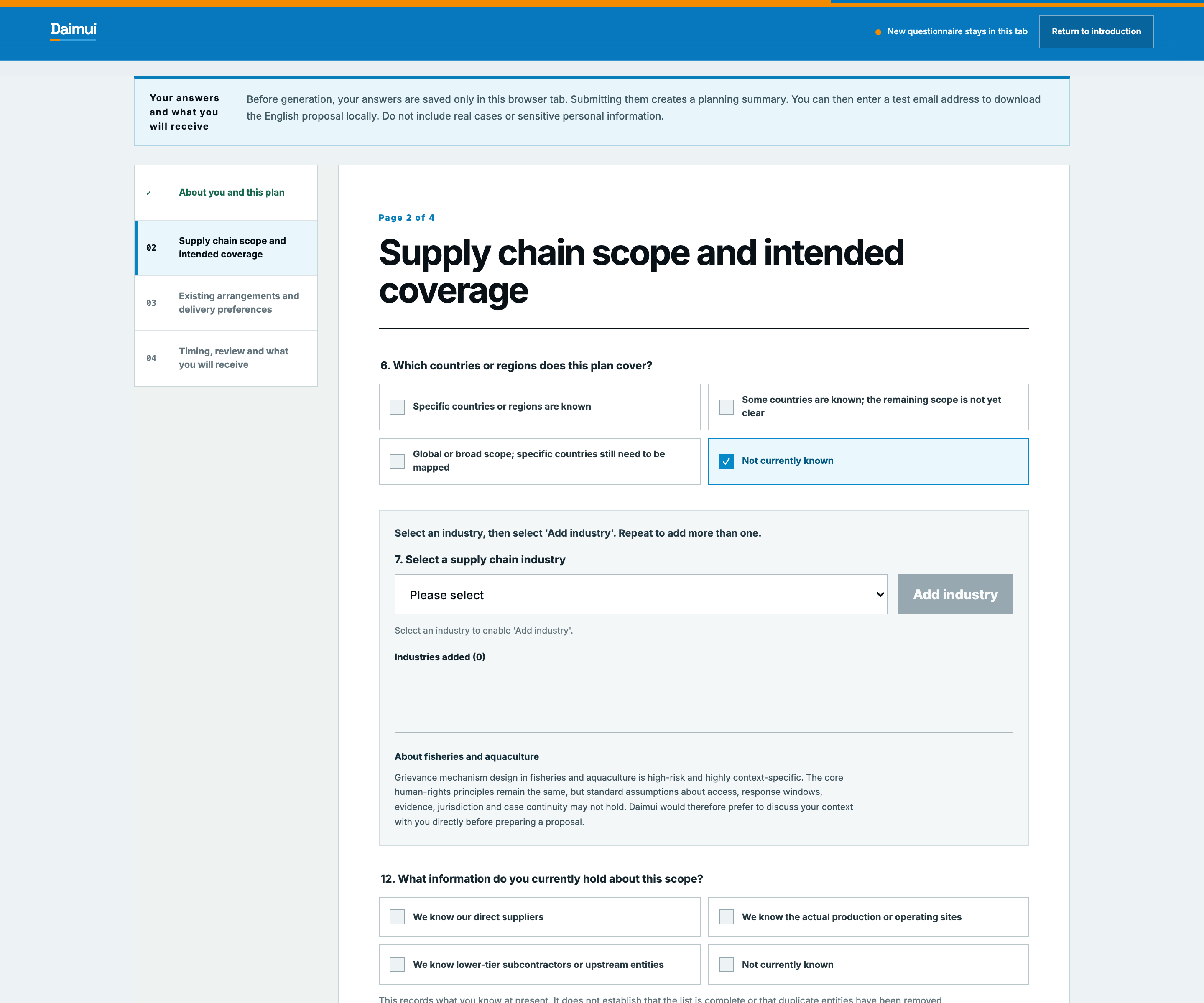
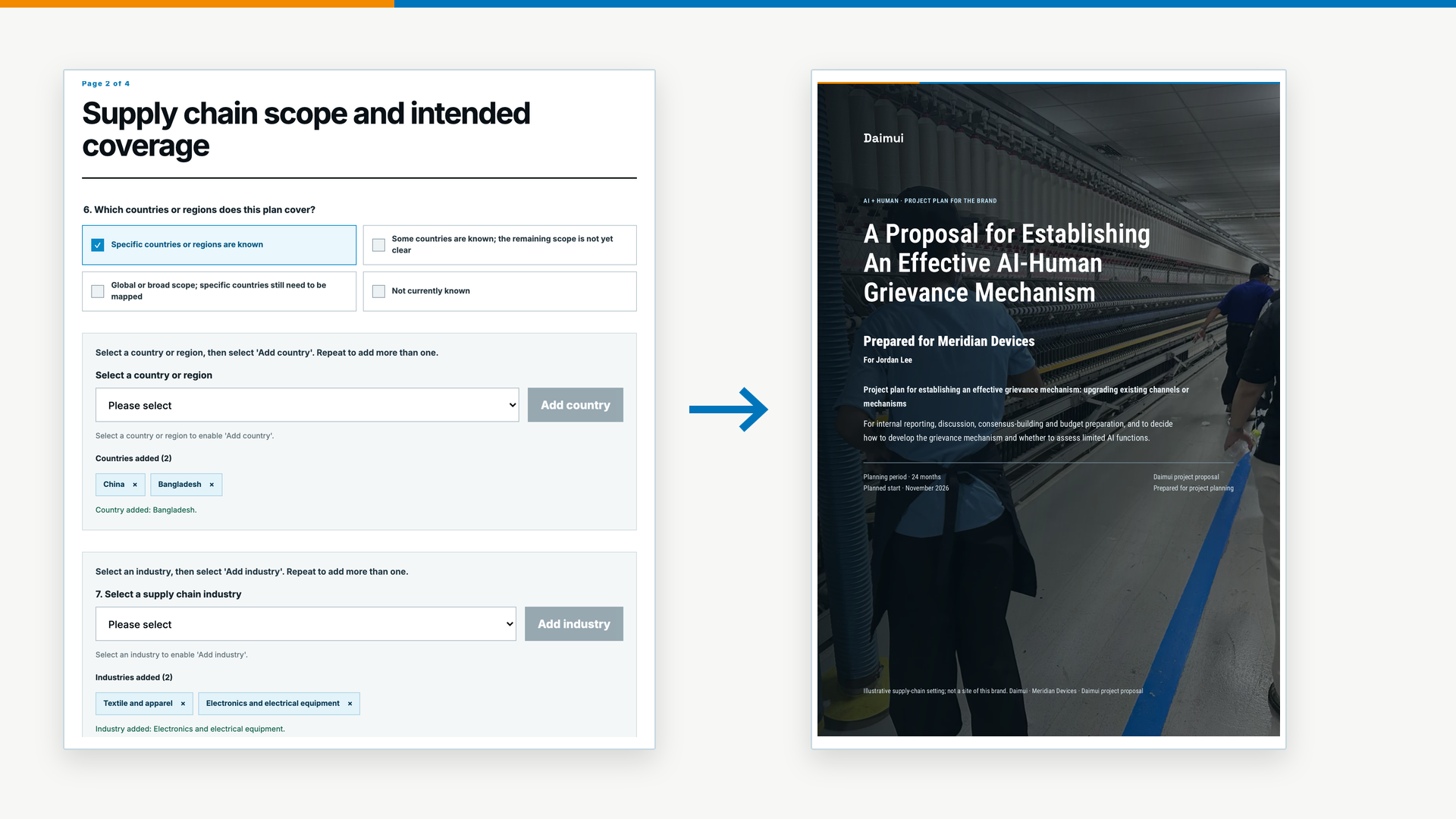
For example, when a capability is recorded as unknown, the plan includes work to verify it before deciding how to proceed. Where a capability is only partly available, the planning approach can identify strengthening work. The conditions affect the proposed work as well as the information shown in the document.
The specialist preparation is already connected: questions, knowledge, standards, judgement, process and method.
What the plan considers
A mechanism needs a connected path through which people can raise concerns, receive a response and seek remedy. Planning considers the following six areas and the responsibilities that connect them.
How can people raise concerns safely? What language, access, privacy and support arrangements need to be understood and tested?
How will the concern be understood? Who identifies urgency, protection needs or a situation requiring immediate escalation?
Who takes ownership? What route is appropriate, who has investigation and decision-making authority, and when is referral or escalation needed?
Who maintains contact, coordinates investigation and agreed actions, and tracks the delivery of remedy?
What should the person raising the concern be told? What information supports oversight and learning, and how will confidentiality be maintained?
What evidence supports closure? How are remedy, outstanding concerns and retaliation risks checked? What review or continuing follow-up is available?
Investigation, decisions and remedy can require movement between these areas. The design must allow urgent action, review and further follow-up when needed.
Where AI support is being considered, the plan examines its place alongside human responsibilities, capabilities and data arrangements. Authorised people remain responsible for findings, decisions on remedy and closure.
These are areas of the mechanism being planned. Daimui supports its design; live case handling takes place through the organisation’s operating arrangements.
What you receive
Begin with a management summary that brings the main planning decisions, priorities and matters requiring verification into view.
The complete A4 project proposal develops the plan across eight chapters:
The document helps colleagues discuss the same scope, review responsibilities and prepare the next decisions. Resource and budget content frames what needs to be considered; it is a basis for further planning and costing.
Getting started
Bring your project purpose, the countries and industries you can identify, known relationships within the supply chain and an initial view of your organisation’s existing capabilities. A complete supply-chain map is not required to begin.
Not sure, Partly and Undecided are useful answers. They help identify the work needed to reach an informed decision.
Choose the main decision, document details and planning horizon.
Identify countries, industries and the intended rollout without inventing unknown relationships.
Review only the country × industry relationships that can be confirmed.
Answer each practical foundation as an organisational judgement, not a certification.
Review facts, planning signals and matters still requiring verification.
Inputs shape the proposed sequence and verification work; they are not treated as evidence of readiness.
Worker access, language, privacy, human handoff, investigation, review and remedy authority.
Use organisational planning information. Keep worker names, allegations, case evidence and other live grievance information out of the planner.
Start planningTaking the plan forward
Agree which decisions need attention, who should participate and what authority or resources the work requires.
Test the assumptions about access, language, safety and how the proposed mechanism would work in their circumstances.
Use the scope, responsibilities and verification needs to explain the work and compare approaches.
Assign follow-up work to the matters still requiring confirmation. Check the proposed arrangements through participation, field validation and specialist review before implementation.
You can use the plan within your organisation or take it to an implementation partner of your choice.
Questions
Daimui’s core is a knowledge-based planning system. Structured inputs, organised knowledge and explicit rules produce the planning decisions and document structure. The core planning process can run without a large language model.
They make it possible to define how a project condition affects a planning decision, preserve important distinctions and check the same relationships again. They also give the team specific knowledge and rules to review as practice develops. Their quality still depends on the knowledge, judgement and maintenance behind them.
The architecture combines a React interface with a Node.js service. Structured knowledge is stored as JSON data; JavaScript rules form the planning results and assemble the proposal. HTML and print styles are rendered to PDF using Chromium. An optional language-refinement step can improve wording after the plan is formed, subject to controls that protect its facts and decisions.
A capable agent can research, use tools and produce a useful plan. Daimui offers specialist preparation already organised for this task: the questions to ask, knowledge to consult, conditions to check, rules to apply and work to include in the proposal. Users can access that preparation through a dedicated planning process. If an agent is given the same methods and tools, it may use them too; Daimui’s value rests on the quality and usability of that specialist work.
The current product is used through its own interface. An Agent Skill could be a future way for an agent to access Daimui’s methods or planning engine. That would be another way to use the specialist capability behind the product.
The team continues to learn through field engagement and review. Relevant lessons can be translated into revised knowledge, questions and planning rules. These updates are made through the team’s knowledge-development work; completing a plan does not automatically retrain the system.
Yes. Provide what you can reasonably confirm and mark what remains uncertain. The plan can include mapping and verification work rather than treating an unknown condition as an established fact.
No account is required. You can review the management summary without providing an email address. A delivery email is requested for the complete PDF. Partnership follow-up and anonymised product-improvement consent are separate, optional choices.
Daimui supports mechanism planning. Live grievances belong in authorised reporting channels. The proposal supports discussion and preparation; implementation still requires appropriate verification, participation and review. It does not certify compliance or mechanism effectiveness.
We plan to open the mechanism-planning decision model for scrutiny, reuse and improvement. Any release will need to identify the material available, its version, licence and conditions of use.